
Car Shipping from China to Uzbekistan: The Complete Transport Guide
Cars are China's No.1 export to Uzbekistan ($1.42B in 2024). Car carrier truck, JSQ6 rail wagons or 40HQ containers — which scheme fits your batch, and what the 2026 customs rules change.
Cars are the largest single commodity in China’s exports to Uzbekistan: in 2024, passenger vehicles worth $1.42 billion entered the country — about 12% of all Chinese exports (China Ministry of Commerce data). Add auto parts and tires, and the automotive supply chain exceeds $2 billion — roughly every fifth dollar in the China–Uzbekistan cargo flow is car-related.
Demand is not slowing down: according to Uzavtosanoat, 91,088 vehicles were sold in the country in Q1 2026 — up 20.9% year on year. Chevrolet’s share fell from 82.6% to 79.3%, and the freed-up space is being taken by Chinese brands: the ADM plant in Jizzakh (Kia, Chery, Haval) holds 12.0% of the market, BYD Uzbekistan Factory 8.6%. In 2025, nearly 60,000 EVs and hybrids were imported — 12% of all new car sales.
For dealers and parallel importers, this makes two questions urgent: how to ship and how the 2026 customs rules change the deal’s budget.
Customs rules changed on January 1, 2026
The preferential duties on small-engine cars that had applied since 2023 expired on January 1, 2026. Previously, cars with engines up to 1,000 cc entered at 0% and up to 1,200 cc at 5%; now standard rates apply — for new cars under one year old, duty starts at 15% of the customs value.
When budgeting, also account for:
- VAT at 12% — charged on the customs value plus duty.
- Utilization fee — levied on wheeled vehicles in Basic Calculation Units (BRV) and has become a significant cost item.
- Certificate of origin — since late February 2026, its absence can add 5–20% duty on top of the standard rate.
The takeaway: choose transport only after a full customs budget calculation — cheap freight paired with expensive paperwork can easily break the economics of the deal.
Three delivery schemes: which one fits you
Car carrier truck — the fastest option
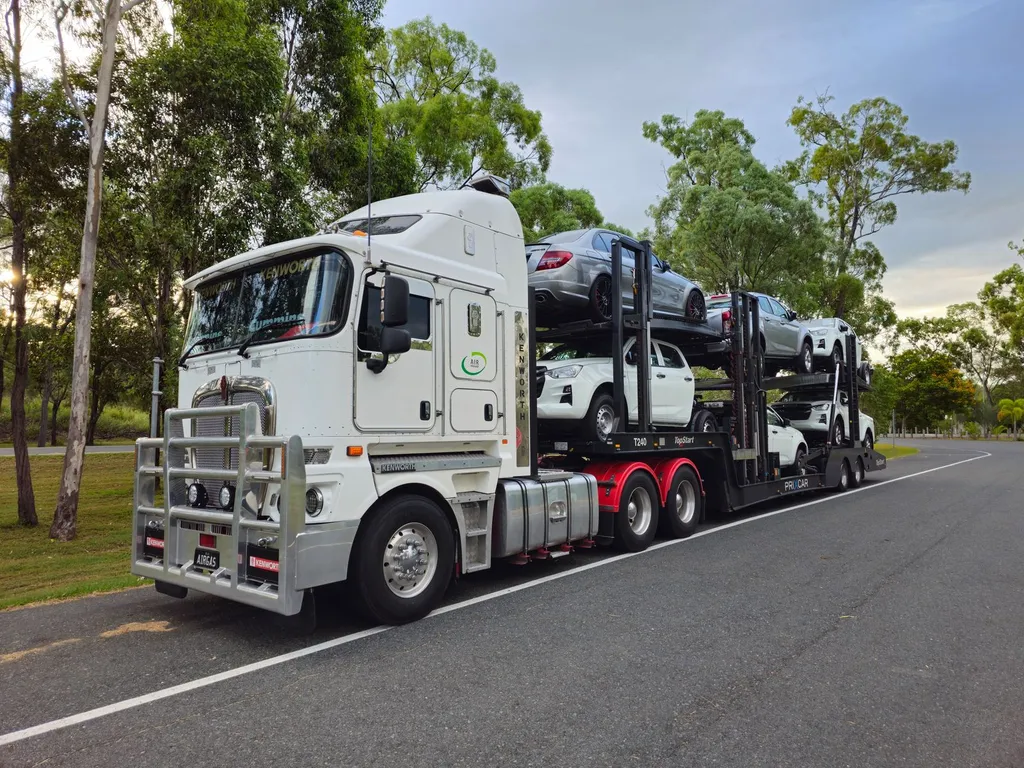
The main route: consolidation anywhere in China → Khorgos → Almaty → Shymkent → Tashkent. A carrier takes 6–8 vehicles and runs directly without long border stops. In practice the Khorgos–Tashkent leg closes within a week; including batch assembly and paperwork in China, door-to-door is usually budgeted at around two weeks (common industry estimate — the exact term is fixed in the contract).
This scheme is optimal for small batches (1–8 cars), dealers with fast turnover and trial shipments. Pricing is per vehicle — on a large batch the unit cost comes out higher than rail.
Rail: JSQ6 wagons and containers — for large batches
For dozens or hundreds of cars, the main channel is Central Asian block trains via Khorgos or Alashankou. Two variants:
- Specialized JSQ6 wagons — double-deck, 8–10 cars per wagon; for serial factory shipments.
- 40HQ containers — 2–3 cars on a special frame; convenient for mixed batches, EVs and models requiring extra protection.
Transit to Tashkent (Chukursay or Sergeli stations) usually takes around 10–14 days, depending on the terminal and queues. The container’s big plus is protection and cargo integrity; the minus is that loading and unloading operations at the border extend the timeline. Details: Khorgos and Alashankou — Tashkent container trains.
Why RoRo does not work here directly
Uzbekistan is a double-landlocked country: neither it nor its neighbors have a seaport. So ocean RoRo services, popular on Middle East and Europe lanes, appear here only in complex combined schemes — in most cases an overland car carrier or rail is both cheaper and faster.
For the Fergana Valley (Andijan, Namangan, Fergana) there is a separate option: Kashgar → Irkeshtam → Osh — direct delivery without entering Kazakhstan. For batches bound for the valley this shortens the leg — details on the road freight page.
The paperwork: what to prepare in advance
- Export license (on the China side) and a foreign trade contract.
- COC — Certificate of Conformity — for Uzbek homologation.
- UN38.3 — battery safety report for EVs and hybrids; without it a car will not be accepted on rail.
- Certificate of origin — to avoid the additional duty mentioned above.
- Useful for large importers: since August 2026, mutual AEO recognition between China and Uzbekistan has been in force — cargo from certified suppliers faces fewer inspections and priority clearance. Details in our separate analysis.
How to choose: the practical summary
| Batch size | Recommended scheme | Main reason |
|---|---|---|
| 1–8 cars, fast turnover | Car carrier (Khorgos) | Shortest lead time, flexible schedule |
| 10–100+ cars, planned imports | Rail (JSQ6 / 40HQ) | Low unit cost, stable schedule |
| EVs, premium models | 40HQ container | Maximum protection, simpler UN38.3 control |
| Fergana Valley destination | Southern route via Irkeshtam | Shorter leg, no Kazakhstan transit |
Final reminder: the 2026 rules make the customs budget the most sensitive part of the deal — savings on transport should only be evaluated together with a full calculation. UZLogis runs car imports turnkey: consolidation at our warehouse in China, export paperwork, choice of car carrier or rail, and customs clearance in Tashkent. Contact us — we will propose the optimal route and an exact estimate for your batch.