
51 Million Tonnes Between China and Central Asia: A Single-Gateway Corridor, and What It Costs You
The EDB's November report puts China–Central Asia land freight at 51 million tonnes in 2025, with 84% moving through Kazakhstan and every rail box crossing at Dostyk or Altynkol. Road freight is growing faster than rail — here is what that means for importers into Uzbekistan.
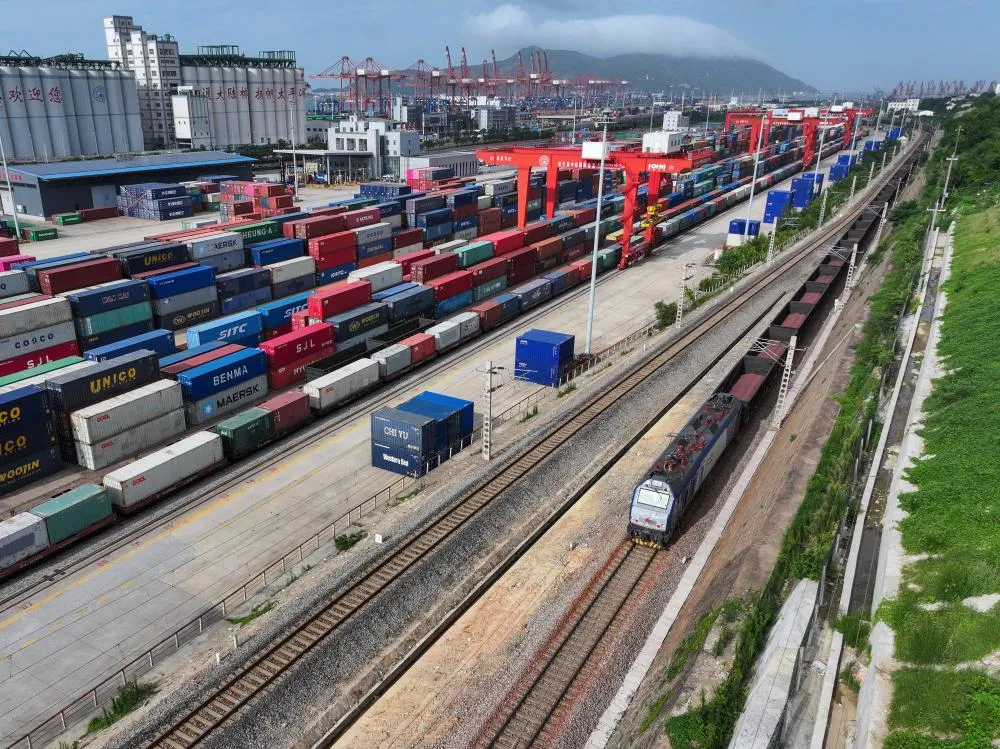
On 19 November the Eurasian Development Bank published its report on transport connectivity between China and Central Asia. The headline number is unglamorous but useful: 51 million tonnes of freight moved by rail and road between China and the five Central Asian states in 2025. Rail carried 35.6 million tonnes, road carried 15.4 million tonnes — roughly seven in ten tonnes went on steel wheels.
For an importer, the value is not the total. It is the shape underneath it.
The report in one table
| Metric | Figure | Period |
|---|---|---|
| China–Central Asia land freight | 51 million tonnes | 2025 |
| Rail share | 35.6 million tonnes (~70%) | 2025 |
| Road share | 15.4 million tonnes | 2025 |
| Growth | +8% year on year | Jan–Oct 2026 |
| Share transiting Kazakhstan | ~84% | 2025 |
| China–Central Asia trade turnover | US$23.5 bn → ~US$70 bn | 2020 → 2025 |
| Uzbekistan–China trade | US$17.5 bn | 2025 |
Trade ran ahead of transport capacity, not behind it: regional turnover with China nearly tripled in five years, and China ended 2025 as Central Asia’s largest trading partner with close to 30% of the region’s goods trade, up from 17–18% in 2020–2021. The International Trade Centre estimates another US$39.3 billion of trade potential remains untapped — about 55% of what already moves.
84% is not a share. It is a single door
Nearly all land freight between the region and China passes through Kazakhstan, and every rail consignment crosses the Chinese–Kazakh border at one of two points: Dostyk or Altynkol.
That is the practical takeaway for anyone shipping to Tashkent, Samarkand or Fergana. The main rail route is not a network with redundancy; it is one corridor with one pair of border crossings. When it runs, everything is predictable. When a holiday peak, a weather event, a queue or a tariff revision lands on it, the entire flow slows at once.
This is also why the southern branch — rail into Kashgar, then road through Kyrgyzstan — stopped being a niche experiment. It is the pressure valve, and the volumes prove it is being used.
Why trucks are winning share
The EDB is explicit that road freight between China and Central Asia is growing faster than rail, and names three causes:
- SME growth. Smaller shippers move smaller lots, and a part-load fits a truck far more easily than it fills a block train;
- Simpler cross-border rules. Bilateral agreements now let carriers deliver deeper into the neighbouring country without transferring cargo between vehicles at the border;
- Digital permits and eTIR. Electronic permits for international road haulage and the eTIR transit system are cutting the paperwork at the crossing.
The third point is already live in Uzbekistan; we covered the shift to electronic road freight permits separately.
The report also flags a constraint that rarely makes headlines: Central Asia lacks modern Class A warehousing. That is not a footnote — it limits what can be handled at destination, and it pushes storage costs up exactly when peak season arrives.
Uzbekistan’s lane grew 53-fold
The most striking Uzbekistan-specific figure concerns the multimodal route through Kyrgyzstan: cargo runs by rail across China, is transferred to trucks, and enters Uzbekistan overland through Kyrgyzstan.
- 2020: 33,700 tonnes
- 2025: 1.8 million tonnes
- Growth: roughly 53 times
Five years ago this was a workaround. Today it carries volume, which means scheduled departures, competing carriers and a tariff structure you can actually plan against. The trade-off has not changed: a second handling point, and a mountain section that answers to the weather.
The CKU railway: a 20-million-tonne promise, still a construction site
The report also sizes the next step. The China–Kyrgyzstan–Uzbekistan line will run 523 km from Kashgar to Andijan — 213 km in China, 260 km in Kyrgyzstan, 50 km in Uzbekistan — via the Torugart pass, Makmal, Jalal-Abad and Kara-Suu. As designed, single track gives 7 million tonnes a year; a second track plus electrification would take it to 20 million tonnes.
The caveat matters more than the capacity figure: the line is still under construction, and no commissioning date has been officially confirmed. Building a 2027 supply plan on the CKU today is a bet, not a plan. Work with the corridors that exist.
Five things to do with this
One: stop planning around a single gateway. Your rail box will cross at Dostyk or Altynkol — that part is fixed. But keep a live alternative in the contract: truck via Khorgos, or rail-to-Kashgar with an Irkeshtam road leg.
Two: book before the peak, not during it. Eight percent growth funnelling through 84% of capacity in one corridor produces one predictable outcome: the tightest space and the worst rates land in the pre-holiday and year-end windows.
Three: match the mode to the lot. Road is faster and more flexible, and more expensive per tonne. Rail is slower but stable, and it wins on volume — the crossover usually sits somewhere around 15–25 cubic metres.
Four: solve the warehouse before you ship. A Class A shortage is a line item. If you take delivery in Tashkent, Samarkand or Fergana, agree storage terms before the container leaves China.
Five: get the papers right at origin. The faster the route, the more expensive the error. A wrong HS code or a weight mismatch will not surface at the border — it will surface at your warehouse, when correcting it costs the most.
Where UZLogis fits
We run all three schemes out of China into Uzbekistan under one contract: rail freight, road freight, and the combination of the two. On the Khorgos and Alashankou — Tashkent container train we quote current schedules and rates on request; for a sense of how quickly capacity is shifting on that lane, our note on FESCO’s added Urumqi departures is a useful reference point.
Send the volume, weight and destination city, and we will translate the report’s numbers into a transit time and a landed cost for your actual consignment.