
China–Uzbekistan Rail-Road Freight Grew Up in November: What the Numbers Say, and What to Check Before You Book
Hai'an now leads China on the China–Kyrgyzstan–Uzbekistan lane with 1,207 wagons and RMB 427 million in nine months. Wuhan ran its first rail-road train to Tashkent in November. Here is what the sealed-container model changes for importers, and where the 10-day figure breaks down.
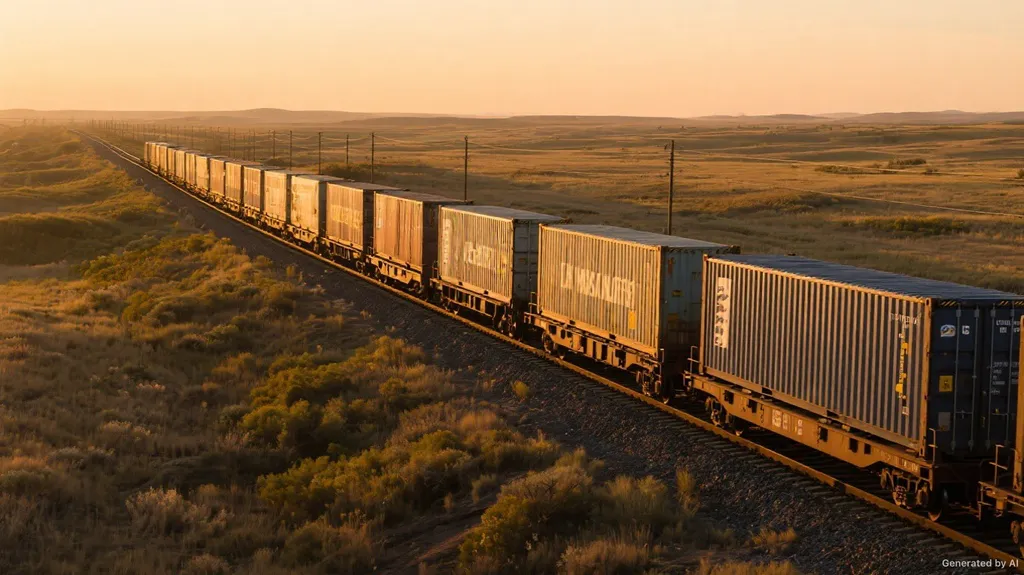
Three announcements in eight days rarely add up to a trend. But in the first ten days of November 2026, three Chinese provinces announced new rail-plus-road services to Uzbekistan almost on top of each other. On 6 November, Jiangsu reported that its Hai’an service had become the busiest China–Kyrgyzstan–Uzbekistan lane in the country for the first three quarters. On 10 November, Hubei’s first rail-plus-road international train left Wuhan for Tashkent. On 3 November, the Ministry of Transport published a 46-measure programme to standardise multimodal transport across Xinjiang.
Taken together they point at something more useful than another departure ceremony: the paperwork and the handover are being standardised, and that is what an importer actually pays for.
Hai’an’s first place is a maturity signal, not a record
According to Nantong Customs, Hai’an — a county-level city in Jiangsu — ranked first nationwide on the China–Kyrgyzstan–Uzbekistan route by shipment volume in January–September 2026: 1,207 wagons carrying goods worth RMB 427 million.
The mechanics are straightforward:
- Containers are loaded at the Hai’an railway logistics base;
- The train runs to Kashgar North station in Xinjiang;
- The box is lifted from the wagon onto a truck — without being opened;
- Cargo exits at Irkeshtam, crosses Kyrgyzstan and enters Uzbekistan.
Note what this is not: it is not the classic Khorgos–Almaty–Tashkent routing. It is the southern branch, and it exists because the transshipment at Kashgar is now supervised as one movement rather than two. A local line operator puts the saving at two to three days per consignment against conventional arrangements, and quotes the lane at roughly 10 days — a schedule-based figure, not a guaranteed delivery date.
Why “the box is not opened” is the whole story
On 10 November the first Hubei rail-plus-road train left Wuhan for Tashkent via Kashgar and Irkeshtam. Wuhan Customs reports the container is not opened en route, transport and insurance costs are 30% lower and transit is about 10 days shorter; 36 TEU have moved so far. Hubei handled 1,777 cross-border multimodal consignments totalling 132,000 tonnes in January–October.
The mechanism behind it is a customs supervision model the General Administration of Customs has been piloting since September 2024:
- One declaration, at origin. No transit declaration is filed at the transshipment station or at the exit border post;
- One supervision document travelling with the cargo the whole way;
- One contract and one settlement instead of separate rail and road contracts, invoices and handovers.
The old model meant unloading, storage, reloading and a second examination at the border — each step a document, a fee and a risk. Customs authorities put the saving at two to three days per consignment, with Huangpu Customs reporting an overall clearance efficiency gain above 30% on its China–Kyrgyzstan–Uzbekistan services. Xi’an’s port group says the rail-road service it launched in November 2025 cut the full journey from 25 days to 20.
There is a cost side that press releases tend to skip: because the box is never opened, the data filed at origin is the data that arrives in Uzbekistan. Being able to fix papers at the border is gone. Precision before departure replaces it.
The November scoreboard
| Origin | Figure | Period |
|---|---|---|
| Hai’an (Jiangsu) | 1,207 wagons, RMB 427 million | Jan–Sep 2026 |
| Wuhan (Hubei) | first train, 36 TEU, costs −30%, transit −10 days | November 2026 |
| Xi’an (Shaanxi) | 25 days cut to 20 | since November 2025 |
| Zengcheng West (Guangdong) | 149 trains, over RMB 300 million in trade value | May 2025 – July 2026 |
| Guangyuan (Sichuan) | first Central Asia train, 55 wagons | 31 October 2026 |
One more date worth noting: on 5 November, Uzbekistan’s Chamber of Commerce and Industry and the Tianjin branch of CCPIT discussed logistics cooperation, including projects tied to the under-construction China–Kyrgyzstan–Uzbekistan railway. A Tashkent business forum is scheduled for 29 November – 5 December.
What an importer should actually do
Plan on a 10–20 day band. Ten days is an operator’s schedule calculation. Winter weather on the Irkeshtam pass, Torugart closures, border queues, Kyrgyz transit permits and the distance to your final warehouse all move the number. Fit your warehouse slot and customs broker to the band, not to the press release.
Consolidate at one station. The economics start with a full container. Lots of 3–5 m³ are still better as groupage truck freight; from roughly 15–25 m³ the container maths usually wins.
Fix the documents before dispatch. With a sealed box, a wrong description, HS code, weight or packing type surfaces at delivery, not at the border — where it is expensive to correct.
Know which cargo fits. Building materials, furniture, appliances, spare parts, plastics, textiles, tin and glass packaging: dense but not urgent. Batteries, cold chain and highly fragile goods carry separate packing rules and permits.
Keep a fallback lane. November and December are peak season in China — the 11.11 sales and year-end shipments fill both warehouses and border posts. Have the Khorgos container train priced as a backup before you need it, not after your main lane stalls.
Where UZLogis fits
We run the southern branch under a single contract: rail freight to Kashgar and the Irkeshtam–Andijan road leg onward through Uzbekistan. That covers cargo acceptance at the origin station, container sealing, document checks before dispatch, border monitoring and delivery to your warehouse in Tashkent, Fergana, Samarkand or anywhere else on the network.
If you are shipping from China in November or December, the useful conversation is a costed comparison rather than a rate card: send the volume, weight and destination city, and we will put the rail-road corridor, groupage trucking and the classic block train side by side for your cargo.
For context on how this corridor started, we covered the first such train out of the Yangtze River Delta in July 2026 here.